08 May 2022

Welsh Bridges: 22. Cwmcoch Footbrige, River Wye

This is the next crossing of the River Wye upstream from  the Cwmbach Footbridge discussed in my previous post.

It was built in 1967 by N.R. Hope of Newbridge-on-Wye, a "swing" suspension bridge of total length around 53m. A wooden beam bridge had previously spanned the river here, before being destroyed in the 1960 floods.

If you were unaware that this bridge existed, you would never look for it. I parked in the entrance to a farm track (although I can't recommend this) on the A470, and walked downhill. There is also space to park on the minor road on the opposite side of the river.

And indeed ... there was no bridge to find. At least, not one that you can still cross.

Powys County Council have no record of the bridge, suggesting this may have been a private bridge as there is no recorded public right of way.

However, Alan Crow's book Bridges on the River Wye, indicates that the bridge was built by the council, after an application to the Ministry of Agriculture and Fisheries for a grant to build a vehicular bridge was rejected.

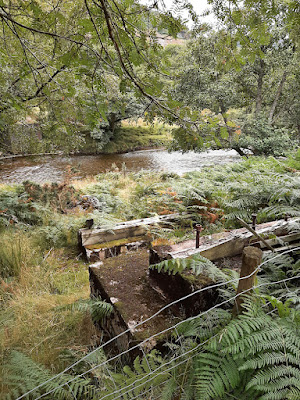
Considering that the remains of the bridge are still visible, attached to the western abutment, I guess that this bridge may have been destroyed in the floods of February 2020.

Peering closely at the debris of the bridge, it can be seen that there was a timber walkway, three planks wide, supported on timber cross-members. Below these are a set of six parallel wires, an arrangement similar to the Invermark Footbridge in Scotland. The remains of suspension towers and cables are also just about visible.

I have included a picture of this bridge from Crow's book, to show it as it once was.

Further information:

07 May 2022

Welsh Bridges: 21. Cwmbach Footbridge, River Wye

Back in August 2021 (yes, time has been moving slowly here at Pontist Towers), I had the chance to look for three interesting footbridges along the River Wye in Powys. I had discovered all three in Alan Crow's excellent 1995 book Bridges on the River Wye.

Unfortunately, my search was less successful than I had hoped!

To reach the first of these spans, I parked in a layby on the A470 (see Google Maps link below), then crossed the road and headed downhill towards the river. Slightly further south, a public right of way is marked on the OS map, but no bridge is shown.

Crow's book records that a "swing" bridge was built here in 1962, to replace a structure that had been destroyed by a flood in 1960. This is the term "swing" bridge in its colloquial sense, referring to a slightly unstable suspension bridge. It was demolished in 1991 on safety grounds, and a new bridge was installed in August 1994 by Tysons plc, of Liverpool.

This was the bridge I had come to see: an arched beam bridge constructed in laminated timber, described by Crow as "one of the most attractive small bridges on the River Wye".

Sadly, there was no bridge to be found. If you look very closely at my main photo, perhaps you can spot the abutments.

The concrete abutments are still there, as are the remnants of steel hinges attached to them. Originally, there was third hinge at the crown of the arch as well.

It's an attractive river setting, and it was disappointing there was no bridge.

Powys County Council have told me that the bridge was removed for safety reasons in 2013, "as it had reached the end of its working life". There are no plans to replace it. I imagine the public right of way saw very little use before anyway.

Since there was little else to see here, I have included an image from Alan Crow's book showing the previous bridges.

Further information:

27 July 2021

Email subscriptions update

Hello!

Yes, it's me.

This is a quick note aimed at the 314 readers who subscribe to get updates from the Happy Pontist via feedburner. That email subscription service is going to be switched off in August.

I am looking to transfer all email subscribers to the alternative platform follow.it instead. If you think you'd rather no longer receive emails from the Happy Pontist, that's fine, just click on any emails you get from follow.it to unsubscribe.

Obviously, blog posts are few and far between right now, but I'm not shutting the blog, so hopefully there will be more to come!

13 May 2021

Yorkshire Bridges: 33. Western Bank Bridge, Sheffield


Ah, it was good to get out and see an actual bridge again.

I'm not quite sure how I missed this beauty on my previous visits to Sheffield, but never mind.

It was built in 1969 to a design by Ove Arup and Partners and architect Yuzo Mikami. I say "it", but actually there are two bridges here, as shown in the cross-section below.


The bridges carry the steeply sloping A57 Western Bank highway above a pedestrian concourse area in the University of Sheffield campus. They are two-span structures, supported on single bearings below their tetrapodal centre pier, and a pair of bearings at each end.

The bridges were built in a period when the University campus was expanding, and the growth in road traffic had led to the highway being upgraded to a dual carriageway. Up to 10,000 pedestrians were reported to be crossing the road every day before the bridges were introduced.

The reinforced concrete slab decks vary in depth, being 1.2m deep over the central support and 0.84m at the abutments. It's a subtle feature that is not immediately obvious visually due to the large footway cantilevers on the edges of the deck.

Both decks are slightly curved in plan, but as can be seen in the photos, the main bridge deck slabs are straight, with the edge cantilevers varying in width to provide the curve.


From above, there is very little of interest to see. The interest is in the space created underneath the bridge. From below, this is a concrete roof held up on finger supports and providing some shelter from the weather. Glass blocks allow light through the central strip, and recently new lighting has been installed to make this a more attractive space at night.

It's a classic of modernist design, with some similarities to both Kingsgate Footbridge (1963) and Drochaid a' Chaolais Chumhaing (1984). The attraction is in its balance between the monolithic and the skeletal; it's clearly one "thing", like a sculpture, rather than one thing sitting upon another thing, like a conventional two-span road bridge.

The tetrapod supports have an interesting blend of straight and curved geometry: the outer edges form an inverted pyramid, while the inner surfaces of each arm are profiled with the curves of two intersecting hyperbolas. I'm not 100% convinced about the way the arms meet the deck slab and wonder whether a different detail would have been preferable e.g. having the arms project slightly from the side faces of the slab to give more of a "cradling" effect.

The sloping faces in front of the abutments were a conscious design choice, not so much to provide seating as to avoid the "tunnel" effect common to subways with vertical walls. The aim is to integrate the bridge with the adjacent landscaping. I guess the central tetrapods represent a similar visual impulse.

The block seating around the supports is not original. I wonder to what extent it was added to stop drunken students from bashing their heads into the angled support struts?

The concrete appears to have weathered well, and I'm left wondering why such a well-designed bridge isn't a little better known.


The article about the bridge in Arup Journal is well worth reading, including some excellent photographs, design drawings, explanations of the structural analysis, and an unexpected anecdote about students in mini-skirts.

The bridge was rewaterproofed, repaired and had new bearings installed in 2016.

Further information:

08 May 2021

"Link it! Masterpieces of Bridge Design" by Chris van Uffelen

There ought to be a name for this sort of coffee-table architecture book, churned out seemingly by the dozen every month, heavy on the photos, light on text, and filled with an uncritical gosh-gee-whizz approach to its subject. Publishers like Braun have a formula that works, whether the book is about bungalows, home conversions, factory design, corporate gardens, cinema architecture, bamboo architecture, apartment buildings, or, eventually bridges. And all those examples are just a small part of the output from one author, Chris van Uffelen.

Something similar can be found on architectural websites like Dezeen, Archboom, Architizer and Designboom: an ever-growing torrent of archi-gloss, much of it unedited from designer's self-promotional submissions. And make no mistake: it is responsible for a genuine and substantial dumbing down of how "design fans" perceive the built environment, such that even the worst examples of toxic architectural bloat are slurped down like nectar by an audience increasingly addicted to the hyperreal and incapable of rational analysis.

None of which is to say that I find nothing of value in "Link it! Masterpieces of Bridge Design" (Braun Publishing, 2014, 208pp).

This is essentially a sequel to van Uffelen's "Masterpieces: Bridge Architecture + Design" (2009), which I reviewed when it came out. I say "van Uffelen" as if he wrote these books, but they are actually put together by "Editorial Office van Uffelen", who provide publishers with the complete ready-made coffee-table service, even if much of that is simply emailing suitable architects and asking them to submit their marketing material. A disclaimer at the end of the book makes clear that if anything is incorrect, it's the fault of the design firms, not editors or publisher.

So: there's almost nothing in the book that you can't find freely on the internet, and essentially you're paying to fund the marketing efforts of the designers who participate in the publication. And yet ... there are plenty of structures and projects in this book that I was unaware of and intrigued to discover.

"Link It!" includes a smattering of generally remarkable bridges that should be well-known to dedicated pontists: Dublin's Samuel Beckett Bridge; the Millau Viaduct; the Hovenring; the Passerelle Simone-de-Beauvoir; Calgary's Peace Bridge; Jerusalem's Bridge of Strings; etc. I am sure these will be interesting and attractive examples of bridge design for the non-specialist (who are obviously the book's core audience).

Beyond that, there are bridges in China, Austria, Germany, Canada, the Netherlands, Belgium, Denmark, Indonesia which are interesting, in some cases attractive, and often have features that a designer could take inspiration from, or in others spot details to avoid. The quality of the designs is, inevitably, uneven, and each bridge has minimal explanation and certainly nothing in the way of criticism. There are, thankfully, only a handful of complete stinkers amongst those that have actually been built.

I mention that because the book also features a number of unbuilt bridges, generally with little or no detail on when they may be built, or whether they will happen at all. Some clearly won't, like the daft "Bouncing Bridge" proposed in Paris, the deliberately conceptual "Hydraspan" proposed for San Francisco, or the notorious Kazimierz Ludwinow Pedestrian Bridge, in Krakow, Poland.

There are a few designs which I would hope even the more cynical pontist would find appealing. Examples include the Wupperbrucke in Leverkusen, Germany; the timber truss Enniger Bridge in Switzerland; the Phyllis J. Tilley Memorial Footbridge in Texas; and the Green School Millennium Bridge, in Bali. Sadly, it's not hard to think of plenty of other fine bridges that didn't make the cut.

The photographs throughout the book are generally of an excellent quality that show off the subject matter to its best, although they are often the "day-before-opening" images beloved of the architectural press, showing the bridges pristine and generally unsullied even by people or traffic.

In summary, it's best to see this sort of book as a glossy brochure, assembled without any expert curation; but which can still provide some pleasant browsing if not taken too seriously.
02 May 2021

"The Architecture of British Bridges" by Ronald Yee

Where does engineering end and architecture begin? That's the question I was left with after reading Ronald Yee's wide-ranging and informative "The Architecture of British Bridges" (Crowood Press, 2021, 224 pages).

Books on the bridges of Britain tend to fall into three camps: big national surveys; more selective surveys following the author's specific tastes; and studies of niche topics like railway bridges. The new book by specialist bridge architect Ronald Yee surprised me by coming closest to the first camp.

The core of the book is a survey of bridges from around the UK, not comprehensive but very well-chosen. This is bookended by an introductory chapter on the architecture of bridges, and two final chapters on bridge parapets and lighting. There is a useful index but nothing in the way of references or bibliography.

Since much of the first chapter is given over to a layperson's guide to different structural forms, there are actually only three or four pages which specifically tackle the architecture of bridges. I had definitely hoped to read more about this, given the author's own area of expertise. There is a bit of a gap in the market here, as most books and articles about bridge aesthetics are written by engineers, not the architects who now play such a key role in bridge design.

Yee's own architectural approach is one that is very closely aligned to the engineering: he is not one for the outlandish or decorative. His approach to the book's topic is to "show, not tell", allowing the idea of good bridge architecture to emerge through example rather than through a didactic approach.

The message I got from the main part of the book is that Yee sees architecture and engineering as being to some extent complementary and to some extent inseparable. Bridges from all periods are described straightforwardly, with the same attention given to how they work (structurally), as to their place in history, their visual appearance, or their local context. Yes, they may have specific architectural attributes (the description of Chester's Grosvenor Bridge includes its "archivolts of red Peckforton sandston ashlar" and "a frieze and cornice with rectangular modillions", amongst other features; Stirling's Forthside Footbridge's "visual effect is gymnastic and an undeniably spectacular sight"), but these are never anything other than part of the wider story.

This leaves many of the individual bridge entries a little dry, even where the bridges themselves can be seen to have some degree of special interest. In other cases, Yee ventures more of an opinion and I'd certainly like to have seen more of this.

The key strength of the book lies in how well the entries have been curated, and illustrated with generally excellent photographs. Given that Yee is well known for his sketches and drawings, I'd love to have seen more of those - they are few and far between.

I have read many books about bridges in Britain, but I still found plenty here that I was unaware of or which has not been celebrated previously in print. It surveys an excellent range of often exemplary bridges, at all scales great and small.

Presenting the bridges in a gazetteer format, structured by materials and bridge typology, does mean that much is left unsaid about architecture: the way in which bridge design in Britain moved through phases of craft construction, master builders, the era of "scientific" engineering, and the slow and then more rapid rise of architects as the leaders of the design narrative. Yee's book therefore leaves room for some very different treatments of the subject, and hopefully others will step into the breach.

22 April 2021

"Transporter Bridges: an Illustrated History" by John Hannavy

Transporter Bridges by John Hannavy (Pen and Sword, 268pp, 2020) is, I think, the first book to bring these unusual structures together in a comprehensive record. Subtitled "An Illustrated History", this is indeed a highly pictorial and well-detailed account of what was a very short-lived type of structure. Nineteen were built between 1893 and 1916, before the growth in motor traffic made them a less attractive form of river crossing.

The concept of a transporter bridge dated back to the mid-19th century. At a time when tall boats still used major rivers, there were essentially four ways to transport vehicles across such an obstacle. Ferry boats were common, but could only carry a few vehicles at a time, and could be unreliable. Fixed bridges were the highest-capacity, most reliable solution, but expensive both in construction and land-take. Moveable bridges were, in their earlier years, complex and expensive, and suitable only for moderate spans. The transporter bridge could cover longer spans, but carrying loads more in line with those on a ferry.

Hannavy documents early proposals for transporter bridges in detail: H.N. Houghton's idea for a railway crossing in New York (1852); J.W. Morse's plan for a similar crossing (1869); Charles Smith's proposal in Middlesbrough (1873); and others.

However, the first proposal to be built was the Viscaya bridge at Portugalete near Bilbao, completed in 1893. The designers Alberto Palacio and Ferdinand Arnodin took out patents for the transporter concept, and Arnodin went on to complete eight more such bridges.

Hannavy's history covers most of the transporter bridges with relative brevity - I say relative as they all get plenty of detail. He takes the story right up to recent decades where new transporter bridges have been proposed (e.g. at Royal Victoria Dock, Nantes, Marseilles and Brest). Of these, the Royal Victoria Dock Bridge is the only that was built, but its transporter gondola was never installed.

Beyond the basic history, the book discusses the "Systeme Arnodin" in detail, and there are chapters covering five of the few surviving transporter spans at length as fine examples of the type: the Viscaya bridge, Newport Transporter Bridge, the Tees Transporter Bridge, Crosfield's Warrington Transporter Bridge (and its now-demolished sibling), and the Rochefort Bridge. A further chapter considers the Widnes-Runcorn Bridge, which was closed in 1961. All five of the transporter bridges ever built in the UK are therefore given close attention.

Each of these is covered thoroughly, with quotes from contemporary journals and an excellent variety of historic and recent photographs. Hannavy's research has clearly been in-depth. The chapter on the Rochefort bridge is particularly interesting, as it mainly documents the massive refurbishment project undertaken to prolong the life of the bridge and to restore it closer to the original Arnodin design.

In addition to the main chapters, the book concludes with a series of one-page summaries of all the known transporter bridges both built and unbuilt.

This is, without any doubt, the definitive book on transporter bridges, and essential for anyone with an interest in them. More generally, it should appeal to those with a broader interest in historic bridges. It is not entirely faultless, unfortunately, as there is no bibliography and no referencing of any sort. This is a shame for any serious researchers, but probably not a big issue for the more general reader.