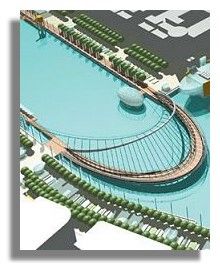
Back in 2005, Spence Associates and Techniker won the RIBA bridge competition for a £43m new highway bridge over the River Wear in Sunderland. The design has never been taken forward, and nor has it ever been revealed to the public. Quite why it is so top secret is anyone's guess, but Stephen Spence is clearly losing patience, as he has now called for the design to be revealed.
Apparently Sunderland Council have even turned down a Freedom of Information request to reveal the design. Spence states:
"You see so many schemes that never even materialise in which they proudly
show the designs. Here we have a lot of the money secured but no
openness."
That hardly seems unreasonable. The local regeneration company, Sunderland Arc, seemed to be using the competition as a way to get wider publicity for their local schemes, but it's hard to see how this can be achieved without actually letting anyone see the winning design.
25 July 2008


C3 #279: "Beyond the Bridge"
 I'd never come across C3 before stumbling over this issue in a bookshop, but it appears to be the 279th issue of a Korean design journal.
What caught my eye, as may be obvious from the cover image, was an absolutely outstanding footbridge, designed by Juan Miró (architect) and Chuck Naeve (engineer). This private structure spans 80 feet (24.3 metres) over part of Lake Austin in Texas, and connects a guest house to the owner's main home. It's an ultra-slender arch comprising five 125mm steel tubes, with the decking and parapets both formed by bending 12mm plain steel bars. It's designed to mimic the lake's natural reed vegetation, and is the sort of one-off masterpiece that could only ever be built for a private client, free from the constraints of disability compliance or crowd loading.
This book / journal has eight pages of photographs, text and drawings of this magnificent bridge, but also devotes plenty of space to several other recent structures. None of these are quite as great, and indeed some are rather mediocre. The bridges include Marc Mimram's bizarre Feng Hua Bridge; Atkins and Grimshaw's derrick-like Newport City Footbridge; an unusual and interesting distorted lenticular truss from Vienna; Thomas Heatherwick and SKM Anthony Hunt's Rolling Bridge; Arup and Wilkinson Eyre's lavish but visually incomprehensible tensegrity bridge; and others. Most of these are simply too recent to have been covered widely elsewhere.
None of the other bridges are anywhere like as glorious as the Lake Austin footbridge, which is a superb piece of engineering and architecture. But they do include several structures worth looking at.
There's plenty more in the magazine, but as it doesn't relate to bridges, I'll say no more here!
22 July 2008
Learning from Bridge Failure
 The Institution of Civil Engineers are hosting a seminar on Learning from Bridge Failure in London on Wednesday 24 September 2008. The agenda includes talks and discussions on past failures, sharing knowledge between public bodies, the Minneapolis bridge collapse, press reporting of failures and how things could be improved in the future.
With the notable recent exception of the collapse of the De la Concorde overpass in Quebec (pictured), which was investigated and reported on comprehensively, problems with bridges (and other structures) are often either unreported or very poorly reported. This may be because details of a failure are not fully shared with the press, or are withheld due to ongoing legal action.
The concern that appears to have prompted this seminar is that if details of failures aren't shared with other bridge owners and engineers, then the opportunity to learn lessons and prevent similar failures from happening may be missed.
In Britain, failures in related industries are in some cases very well investigated and publicised. Notable, the Rail Accident Investigation Branch publishes thorough reports on rail related safety failures. There is a legal duty to notify the RAIB of an accident and to assist their investigations (Railways (Accident Investigation and Reporting) Regulations 2005). There are equivalent bodies for the air and marine industries. However there is no equivalent body which would investigate highway or footway bridge failures - the closest is the Health and Safety Executive. A key difference is that if the HSE investigates a safety failure, it is generally with the aim of prosecuting those responsible. An investigation by the RAIB is intended to share knowledge of the causes of failure, not to apportion liability (although, by making recommendations on what the people involved should do differently, it can't avoid attributing blame).
The problem with all the above bodies is they will only investigate after a failure. If failure led to death, a coroner's inquiry might be sufficient to determine the reason, but would not provide exhaustive technical detail. If the failure is significant enough, a body can be set up to investigate even where none already existed, as happened following several failures of steel box girder bridges with the appointment of the Merrison Committee in December 1970.
There's little doubt that bridge failures have been one of the main sources of technical improvement in bridge design (in addition to Merrison, the cases of the Millennium Bridge, Tacoma Narrows and others are relevant - see Henry Petroski's book "To Engineer is Human" [Amazon.co.uk]). But it's hard not to suspect that there is a great deal of very useful information gathered by forensic engineers and expert witnesses in legal cases and rarely if ever more widely disseminated. While there is a confidential reporting route (CROSS) intended to encourage information to enter the public domain, it seems mainly to address generic problems rather than specific, detailed cases.
I doubt much can be done to remove the obvious impediments to sharing information more widely: client confidentiality; commercial and competitive advantage of limiting the spread of knowledge; fear of costly legal action etc. If anything, the last of these impediments has been made significantly worse by the introduction of corporate manslaughter legislation. One option might be to introduce specific legal limits on liability for negligence (but it seems unlikely that the benefit of encouraging knowledge-sharing will outweight the adverse effects on victims). Another would be to consider mandatory investigation and reporting regimes similar to those that operate in other industries (but this is expensive).
It will be interesting to see whether the ICE seminar can come up with anything which has a more realistic chance of success!
17 July 2008
So you think you're funny, do you?


This one can be found at the Yorkshire Sculpture Park, about 50m south of the main visitor centre. The artist responsible is Brian Fell, but YSP haven't been able to tell me who the bridge designer was.
I like the assymmetry, the way it's like a giant stencil split in half, an idea crying out to be used somewhere else on a more "serious" bridge.
I'm not 100% convinced by the rust colour - it doesn't look in photos quite like weathering steel and even if it was, the detailing would lead to significant corrosion over time in the various sharp corners. It would also have been nice if the side panels actually held up the bridge - from the photos it looks like the deck is strong enough to be self-supporting.
For non-UK readers, a "ha-ha" is essentially a posh ditch. Well, there's more to it than that, but that's the basis of the bridge-as-pun that has been sculpted here.
[Photos from Flickr used with permission]
15 July 2008
RIBA bridge competition ends in nothing
The project to build a new footbridge in Stratford-upon-Avon has come to an unhappy end, and one not entirely untypical of bridge competitions. It has been cancelled due to "spiralling costs".

In 2006, RIBA ran a bridge design competition for a new footbridge over the River Avon in Stratford, garnering over 60 entries. Five entries were shortlisted in November 2006, and the winner announced as Schlaich Bergermann & Partners with Ian Ritchie Architects, with a super-slender steel arch design (pictured). This was an interesting reaction against a trend towards structurally gymnastic cable-supported bridges which had dominated high-profile footbridge design.
The promoting authorities' support for the bridge always seemed to be in doubt. It was promoted by Warwickshire County Council, but there was considerably opposition in the local press to what was seen as an unnecessary scheme, and the council's lukewarm attitude was reflected in consultation after consultation, with associated feasibility reports and pedestrian studies. Most of these were prepared after the competition had already begun, suggesting that a genuine need for the bridge was never conclusively demonstrated.
The original scheme budget was £2m, which is ample for a bridge that is 50m long, and is 3.71m wide. That works out at over £10,000 per square metre of deck, which is plenty for almost any footbridge, however unusual (for dimensions, see the original design submission at Warwickshire's website).
Now, however, Warwickshire have spent £312,000 on getting the bridge to planning submission stage, and have in the process re-estimated the bridge's budget cost at £3.3m, an increase of over 50% and equating to over £17,500 per square metre. Not unsurprisingly, the project has been cancelled, with the council quoted as saying "neither the County or District Councils are in a position to fund the shortfall so we have reluctantly decided to remove the bridge from the World Class Stratford programme." Given that Warwickshire were only going to stump up £0.2m of the original budget (the rest coming from external development funding), it's easy to understand their decision.
So what really went wrong?
The council's original budget certainly wasn't at fault, for what should have been a fairly straightforward and simple river footbridge. There are several competitions where the budgets are unrealistically low, certainly in comparison to the effort expected from entrants. The need for repeated studies and consultations, as well as the low budget contribution from the main stakeholder suggest a lack of commitment which won't have helped. Surely a proper feasibility study prior to holding an expensive competition would have helped establish a firmer case for the bridge (or led to its cancellation prior to spending so much money)?
The council has chosen to blame construction price inflation, particularly steel prices, but any sound project should assess risks such as this at the outset and take them into account throughout. Steel price inflation wasn't an unknown when the winner was chosen in late 2006.
Was there something particularly risky about this design that the council could have spotted and dealt with? The "glasgowbridge" competition was one high profile case where the winning design came in well above budget (like Stratford, subsequently cancelled), and where it was apparent that the design was structurally challenging, to say the least. Was that the case here?
The Stratford design was an arch that was both very slender (50m span and only 350mm thick at midspan, a span-depth ratio of 142), and with a very shallow rise. The former will have made it susceptible to dynamic excitation, and the latter will have created an unusually large horizontal thrust on the abutments, but it's hard not to think that these could both be addressed within the original budget.
The council also cites "additional flood mitigation measures" as increasing the cost, and it may be the case that there are issues beyond the bridge itself affecting the scheme.
I'd ask whether a RIBA competition was the right approach to such a minor structure. The Stratford bridge isn't the only RIBA competition to go nowhere due to uncertain funding and commitment from the promoter - another happened at River Wear in Sunderland.
One lesson perhaps is that ambitions should be scaled to match the resources really available (including the willingness to deal with risks); another could be that the conventional non-competition design process (feasibility study, preliminary design, detailed design etc) may uncover problems at an earlier and more cost-effective stage.
11 July 2008
Squiggly bridge in DDA compliance row
 Poor old Glasgow. It would be no surprise if their city council never built a new bridge again after their tribulations of the last few years.
First there was "Neptune's Way" (shown above right), winner of a lavish competition for a new footbridge between Broomielaw and Tradeston, which was cancelled when the contractor's bids came in well over the council's budget.
Then there was the failure of a hanger on the Clyde Arc (locally nicknamed the "squinty bridge"), resulting in its closure for over 5 months.
 Now there seems to be a problem with slopes on the deck of the Tradeston Bridge (locally nicknamed the "squiggly bridge", and shown on the right). This is the proposed footbridge that replaces the failed Neptune's Way project. According to both the Evening Times and the Herald, there are slopes of up to 15cm on a full-size mock-up of the deck prepared by fabricator Steel Engineering, and these may cause problems for some bridge users.
The reports aren't very clear, but they seem to me to imply a transverse crossfall (i.e. a drop of 15cm parallel to the river). If it were longitudinal (parallel to the bridge span), then it should be straightforward to get up and down 15cm, given sufficient length of bridge. But if it is the crossfall, it's easy to see why it might be difficult for some pedestrians to negotiate - not just the mobility-impaired but people with pushchairs might also find it awkward.
It's odd that this was in the Glasgow press two-and-a-half weeks ago, but doesn't seem to have been picked up in the national civil engineering press. As with many non-technical press reports on bridge problems, it's hard to figure out what's really going on. It may be a storm in a tea cup, a perfectly good design misinterpreted by the fabricator. But I'm sure Glasgow city council would be much happier if the Squiggly Bridge was the one crossing of the Clyde that had gone forwards without any problems at all.
05 July 2008
For historic bridge fans ...
Traditionally, researching bridge history has involved travel to the various venerable institutions who hold rare copies of particular manuscripts, making it a hobby basically for the retired engineer or historian with time to spare. For example, Tom Peters' excellent "Transitions in Engineering: Guillaume Henri Dufour and the Early 19th Century Cable Suspension Bridges" [Amazon.co.uk] features an exhaustive bibliography based on painstaking personal research.
Of course, the internet is beginning to diminish these difficulties. I've been aware for a while that Google Books contains scanned versions of several key books of interest, which can be read online or downloaded as PDFs. These include:
Of course, the internet is beginning to diminish these difficulties. I've been aware for a while that Google Books contains scanned versions of several key books of interest, which can be read online or downloaded as PDFs. These include:
- Charles Stewart Drewry's "A Memoir of Suspension Bridges" (1832)
- Samuel Smiles' "Lives of the Engineers" (1862)
- James Finley's "Description of the patent chain bridge" (in the Port Folio, 1810)
- Thomas Pope's "A Treatise on Bridge Architecture" (1811)
There are dozens of others, many of them great early documents of the pioneering 19th century.
I was unaware until very recently that bibliophiles can get much of the same material in print, thanks to Kessinger Publishing and the University of Michigan's Scholarly Publishing Office. In addition to some of the titles mentioned above, you can find otherwise long out-of-print books by David Steinman, John Roebling, Squire Whipple and many others. Several are unavailable through Google. They can be ordered either through the publishers or through Amazon.
Great for the happy pontist's bridges bookshelf; very, very bad for his wallet.
Subscribe to:
Posts (Atom)


