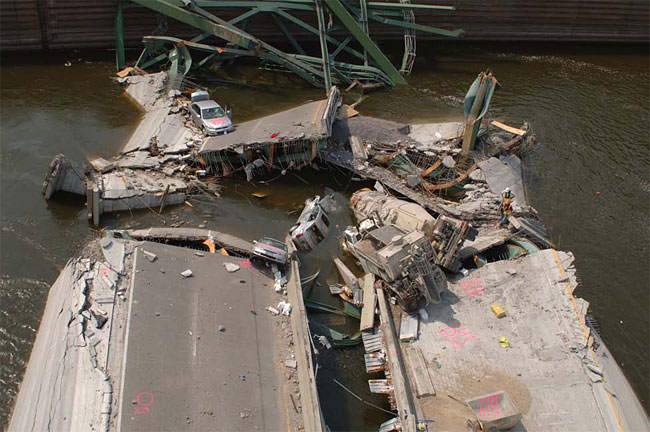
"Understanding Bridge Collapses" (ISBN 0-415-43623-6),
Taylor & Francis, 2008
[Amazon UK] seems to be a very timely book, published as it is following what seems like
a spate of often
catastrophic bridge failures.
There are several books available offering case studies of engineering failure: examples include
"Why Buildings Fall Down" by Salvadori and Levy;
"Design Paradigms" by Henry Petroski; and more structure-specific titles like Peter R Lewis's books
"Beautiful Railway Bridge of the Silvery Tay" and
"Disaster on the Dee". Most of these are a pleasure to read for engineer and layperson alike: Salvadori and Levy's book is a personal favourite thanks to its clear illustrations and explanations. Although both it and the Petroski book cover plenty of bridge failures between them (Tacoma Narrows, Point Pleasant, Mianus River, Schoharie Creek, Hatchie River, Dee Bridge, Britannia Bridge), I'm not aware of a book until now that has focussed exclusively on bridge-related case studies.
Åkesson, a
former lecturer in Sweden, used case studies of failure to help explain complex structural phenomena to students. His aim with "Understanding Bridge Collapses" is to share some 2o examples of bridge failure with practicing engineers, enabling them both to learn from history and also to understand how the history of bridge failure is also a history of increased technical understanding.
The book covers the following collapses dating from 1847 to 2003: Dee, Ashtabula, Tay, Quebec, Hasselt, Sandö, Tacoma Narrows, Peace River, Second Narrows, Kings, Point Pleasant, Fourth Danube, Britannia, Cleddau, West Gate, Rhine, Zeulenroda, Reichsbrücke, Almö and Sgt Aubrey Cosens VC Memorial. In each case, copious technical detail is provided, including detailed formulae, calculations and diagrams describing the failure mechanism and showing why an insufficient factor of safety was present. In this respect, it's a very welcome book because nowhere else is this level of technical detail brought together in one place.
One thing to note is that the book's title is exactly correct; it's about bridge collapses rather than failures more generally. There were several early suspension bridges (e.g. Union Bridge and the Menai Bridge) which suffered terribly due to aerodynamic excitation, but didn't actually fall down (although many of their contemporaries did collapse), and the book also omits examples like the London Millennium Bridge, which suffered a performance failure but again didn't collapse. The latter omission is particularly interesting because the author quotes with approval Sibley and Walker's 30-year cycle of major bridge failures, each of which represented a major turning point in the development of bridge engineering:
Åkesson and Petroski both suggest that on the basis of this pattern the time was ripe for a major cable-stayed bridge collapse around the turn of the millennium. Well, of course, that hasn't happened yet, but the Millennium Footbridge fits the 30-year cycle perfectly, providing a classic example of innovative bridge design pushed beyond the boundaries of current knowledge, and leading to much fruitful research following its failure.
Not all of Åkesson's explanations agree with other authors. Taking Stephenson's Dee Bridge, Petroski blames lateral torsional instability, while Åkesson suggests the culprit is localised plastic deformation of a pin-connection detail. I don't feel that this matters: there's plenty to learn even from an incorrect explanation.
One problem with the book is that there are so many specific details that it doesn't really step back and offer a proper overview. There is very little attention given to the non-technical reasons for failure,
Pugsley's "engineering climatology of structural accidents".
The biggest flaw, however, is the seemingly complete absence of an editor - Åkesson's English is far from perfect, and seems not to have been edited at all. At times it's just awkward, but at others it's genuinely difficult to understand some of the points being made. For any book of this sort to get to print with this little intervention is frankly baffling, and it's a constant source of irritation as you read through it.
So do the good points outweigh the problems? I'd have to say I found the book so badly marred by the imperfect English that I can't really recommend it. It's unique, and a very interesting read, but I find myself constantly regretting what I paid for it. Caveat emptor!