05 December 2008

Bridges news roundup

Squiggly Bridge gets its final link
Most of Glasgow footbridge now on site

Next step for River Wear crossing confirmed
Techniker to review costs and address technical issues with design

Interview with Tom Oslund
Architectural input to the replacement I-35W design (pictured)


Jerusalem mayor plans to demolish brand new Calatrava bridge
£40m light rail bridge could become redundant if light rail scheme cancelled

Portland could get USA's first ever extradosed bridge

04 December 2008

A bridge with a twist

It seems the fashion for post-modernism in bridge design is steadily departing further and further from "normal" structural constraints to the extent that it's no longer post-modernism at all, it's good old-fashioned surrealism.

The latest case in point is a proposed new foot and cycle bridge in Houston, named the "Tolerance Bridge" and planned to cost US$7m. Announcing the winner of a 54-entry "international artistic competition" (whatever that is), mayor Bill White declared that "great art is part of a real city".

Like everyone else in the entire world, they were evidently looking for something unique, a landmark, an icon (etc etc etc), and the design chosen is definitely that. It's not entirely clear from this image, but it's intended to look as if the bridge deck rises up into an arch, twisting around as it does so into something that nobody other than the most ambitious skateboarder could possibly cross. In reality, the bridge deck is at grade. Other images of the design show streetlights on the arch, enhancing the illusion that a giant toddler has vented their frustration on a more conventional bridge.

As a structural engineer, comment seems largely superfluous. The "arch" is purely sculptural, it's not there to hold up the deck below, essentially the entire bridge is a one-note joke. Depending on taste, it's either a welcome dose of humour in a genre normally known for serious structural acrobatics, or it's a case of all common sense thrown overboard. I'm finding it hard to decide which is my view: my sensible structural engineer's heart rebels against the fundamental irrationality of it, while my brain tells me we should all be more open to the eccentric and unpredictable (even if it does cost 7 million bucks). At least one Houstonian seems inclined firmly to the more sceptical view.

Bridges to nowhere

If you had to define a bridge, it would probably be something like "a structure spanning and providing passage over an obstacle" (slightly abrided from dictionary.com, that one). But what about a structure that provides passage above an obstacle ... but not actually over it?

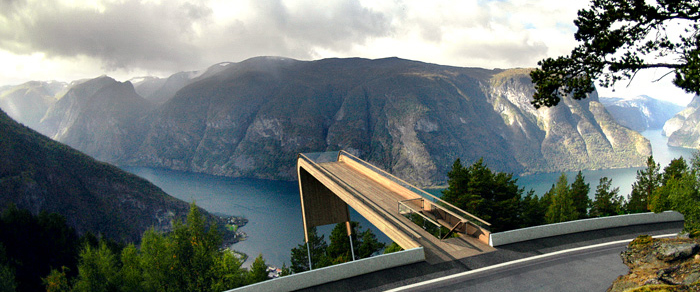
Not sure what that means in practice? Well, Deputy Dog has the answer with a delightful set of six bridges-to-nowhere that take people out into mid-air, and no further. These include the astonishing Grand Canyon Skywalk; viewing platforms in the mountains of Italy, Switzerland and Austria; and Norway's design-conscious but frankly terrifying Aurland Lookout (pictured, photo courtesy of Lewis Martin).


Pontists may also be interested in another recent Deputy Dog post on the use of rockets to build a suspension bridge.

03 December 2008

Sunderland council decide way forward for River Wear crossing

Today, Sunderland City Council's cabinet are meeting to agree the way forward for their iconic bridge scheme (iconic is a much abused term in bridge design, but this is one bridge that if it is ever built, will undoubtedly merit the description).

The Sunderland Echo recently reported that the current Spence / Techniker concept design (pictured) "will have to go out to tender to engineering companies. Experts will then come up with a working design and accurate costings for the structure to see if it will work and be affordable." The Happy Pontist previously wondered whether the current designers might not be too happy to see their work passed on to another firm i.e. the un-named experts.

It seems the Echo's report was slightly misleading; the council's actual intention is to appoint Techniker to develop their own design further. In a report to the council cabinet (available online [PDF]), the council officers recommend appointing Techniker to "continue with the development of the concept design up to a stage where sufficient confidence on cost, risk and buildability can be provided to assess its affordability". No doubt Techniker will be pleased to take back the lead role on this bridge at long last.

The council are definitely taking the risks associated with this highly unconventional design seriously - their report acknowledges it to be "innovative and unique", stating that "a bridge of this type and scale has not been built anywhere else". They want to achieve a comparative level of cost certainty to a conventional bridge, which will require a very substantial amount of design work indeed.

The report discusses the extra £30m required for the iconic bridge (over and above the cost of a conventional bridge), but since it doesn't split out the cost of the bridge from the cost of the wider Sunderland Strategic Transport Corridor scheme (of which it forms part), it's difficult to comment on how reasonable their estimates are. By my estimate, £30m works out at about an extra £3,000 per square metre of deck.

Techniker's designer Matthew Wells has previously suggested that a bridge "of similar size and span and of exactly the same construction and arrangement has been constructed a decade ago without any difficult[y] or on-cost or excessive maintenance regime", so perhaps this will now be an opportunity to tell everyone what that bridge is and use it as a cost benchmark. Perhaps Calatrava's Alamillo Bridge is the best comparison: it cost US$38m when built in 1992, and allowing for inflation that would work out at roughly £5,000 per square metre of deck today. However, the River Wear design is substantially more exotic than even Alamillo, so any benchmark may be futile.

The council report also discusses the recent public consultation. Newspaper polls found over 90% in favour of the Techniker design. However, the council's own consultation finds that only 52% of people were in favour of "a striking design", against 49% wanting something "tried and tested". So with half of Sunderland opposed to the bridge, you must wonder exactly why their council is quite so keen to pursue it.

I sometimes feel as if the River Wear story has taken over this blog (notwithstanding exciting side trips to the Alps), but it undoubtedly has a long way to go yet!

20 November 2008

Swiss Bridges: Epilogue

So that was that, the end of the IABSE Study Tour in Switzerland, and very much back down to earth afterwards.

One of the main things I took away from the trip was how much can be achieved by engineers when they are confident in their creativity, skilled in their art, and (relatively) unimpeded by bureaucracy. Few if any of the bridges we saw had the involvement of an architect, or if one was involved, the structural engineering was central to the design process. Much of this is down to the challenges set by the remarkable Swiss landscape rather than anything else: the engineering absolutely has to take precedence.

That most of these bridges are also aesthetically successful is far from a foregone conclusion. Several of Robert Maillart's bridges are visually clumsy (including one that we visited, Traubach Bridge). These bridges are masterpieces because of the deep involvement and care lavished upon them by their designers. I think bridge designers anywhere can learn what can be achieved when they have a strong vision and can minimise the need for compromise.

David Billington has suggested that all engineers should consider making a pilgrimage to the Salginatobel Bridge. Before this trip I'd have dismissed that as daft idealism, but now I'd quite happily go along with it. There's plenty to learn technically from structurally challenging historic bridges such as these, but more important is what they offer in both inspiration and aspiration.

I know I'm already looking forward to the next study tour!

While in Epilogue mode, can I take the opportunity to ask for more feedback from anyone reading this blog? I'd be keen to hear comments on the bridges, opinions, news or anything else; it would be good to know that someone is reading, and I'm particularly open to discussion, debate or even dispute!

19 November 2008

Swiss Bridges: 7. Traversina Footbridge

From the Pùnt da Suransuns, we walked to our final bridge of the day, and our final bridge of the study tour. Built in 2005, the second Traversina Footbridge is another design by Jürg Conzett, and replaced his previous structure on the site (you guessed it, the first Traversina Footbridge), which had been destroyed by a falling boulder.

One thing that's impressive about Conzett is his ability to apply equal levels of ingenuity and imagination to the design of very disparate structural forms: in addition to those at Via Mala, his Coupurebrug in Belgium is another unusual example. While at first sight the second Traversina Footbridge looks like a relatively conventional suspension bridge, it turns out to be far from conventional and probably unique.

Spanning 56m across a 70m deep gorge, the levels of the hiking trail on each side are very different, and as a result the bridge is a staircase which increases in steepness towards one end. The deck and handrail are a mixture of steel and timber elements, hung from two suspension cables with a truss-like arrangement of hangers. The main suspension cables hang from abutments which are at essentially the same height, with the result that the hangers are short at the upper end of the staircase, and progressively longer towards the lower end.

The geometry and cable forces were derived using that quintessentially Swiss technique, graphic statics, specifically a Cremona diagram. Where many engineers would plunge in with the latest non-linear form-finding software, Conzett gets out a pencil and graph paper and harks back to the methods of a century ago. The trussed hangers make the structure far stiffer than a normal suspension bridge, and in practice it barely sways at all in use.

I've given links below to a couple of websites that have photos of the bridge construction, and these are well worth a look. Building a bridge above a gorge where the only access routes are steep, narrow mountain paths, is quite a challenge. As several people on the study tour noted, the people who work out how to build a bridge are often the unsung heroes of any project. All the five Maillart arches we saw relied heavily on the falsework designer to bridge the gap first, and the erection engineering at Sunniberg would have been a major design package in its own right.

To build Traversina, a specialist firm installed a "cable crane", essentially a travelling crane running on cables strung between the trees. This allowed materials and most importantly the concrete for the abutments to be brought up from much further down the hillside. The cable network and deck panels could then be assembled in mid-air using a helicopter and roped-access specialists. It's quite a feat in a place like this.

The bridge that results is magnificent but also highly peculiar. This was pretty much the only bridge we saw where I got vertigo just crossing it, let alone leaning over the side. I think this was a combination of the precipitous location and the fact that it's a staircase - you never really feel you're on a level platform, and it's mildly disorienting.

It was getting quite late by now, and much of the return journey down the hillside was in near darkness. Looking back across the Via Mala gorge, I could only just make out the bridge, a pale grey ghost amongst dark grey shadows. It did seem afterwards like something out of a dream, the genius loci returning to its home in the spirit world.

Further information:

Sunderland gets its iconic bridge. Or does it?

Time for another quick interruption to my ongoing dissection of all things Swiss.

Sunderland City Council have today announced their preferred design for the new River Wear Crossing, a project which has been rumbling on for some time and may finally be heading towards a resolution.


They've gone for the much-discussed iconic design by Stephen Spence and Techniker (pictured). This RIBA competition-winning design was kept secret for three years, before finally being unveiled in September, and then subject to a somewhat ill-informed public consultation.

Sunderland's decision to go along with the weight of public opinion leaves them with the not-so-minor difficulty of finding an extra £30m to pay for it.

The council's chief exec David Smith is quoted: "It's something that has never been done before in a shape and size like this. An international audience will be talking about Sunderland's bridge." They certainly will - although not necessarily for the reasons that Sunderland might imagine.

To their great credit, Sunderland now acknowledge that the current design may not survive further feasibility study and design development, and will be embarking on further work to "come up with a working design" and firm up the cost. This may apparently include "toning it down". It's not clear where this leaves Spence and Techniker, who might be somewhat disgruntled at someone else taking forward their competition winning bridge.

So, headline is that Sunderland will be getting its iconic bridge after all, but it's clear that this remains far from certain - the funding isn't in place, and the design could still be radically changed or even ditched.