Showing posts with label Ireland. Show all posts

19 May 2019

Winner of bridge design competition for Irish National War Memorial Gardens

The Royal Institute of the Architects of Ireland and the Irish Office of Public Works have announced a winner in their design competition for a new bridge at the Irish National War Memorial Gardens. The bridge will span the River Liffey and provide a new entrance to the Gardens for pedestrians crossing from the river's north bank.

In the 1930s, architect Edwin Lutyens designed a three-span arch bridge at the site, pictured below, but it was never built.


The winner receives a €15,000 prize (and the hope that their bridge may be built). Two runners-up receive prizes of €7,500 and €5,000, and two further entries were Commended. In total, the open competition received 61 entries from 9 countries.

Winner
Ian Ritchie Architects / Schlaich Bergermann Partner


The winning design is, in the words of the designer, "the most slender and shallow structural arch that is technically possible." It is constructed of stainless steel, with parapets in the form of a screen of reeds, and with footprints on the deck surface intended to commemorate soldiers who never returned from war.

There's more than a little sense of déjà vu about this bridge design. The same team also won the Stratford-upon-Avon bridge design contest back in 2006, which was also a super-slender stainless steel arch design. That project was cancelled in 2008 due to escalating costs.

Here's the "calligraphic brush stroke" image which is used on the e-architect website for the Stratford bridge:


And here is an image taken from Ian Ritchie Architects' web page for their new Irish design:


I'm sure the resemblance is entirely coincidental.

Second Place
Weston Williamson + Partners / AKT II
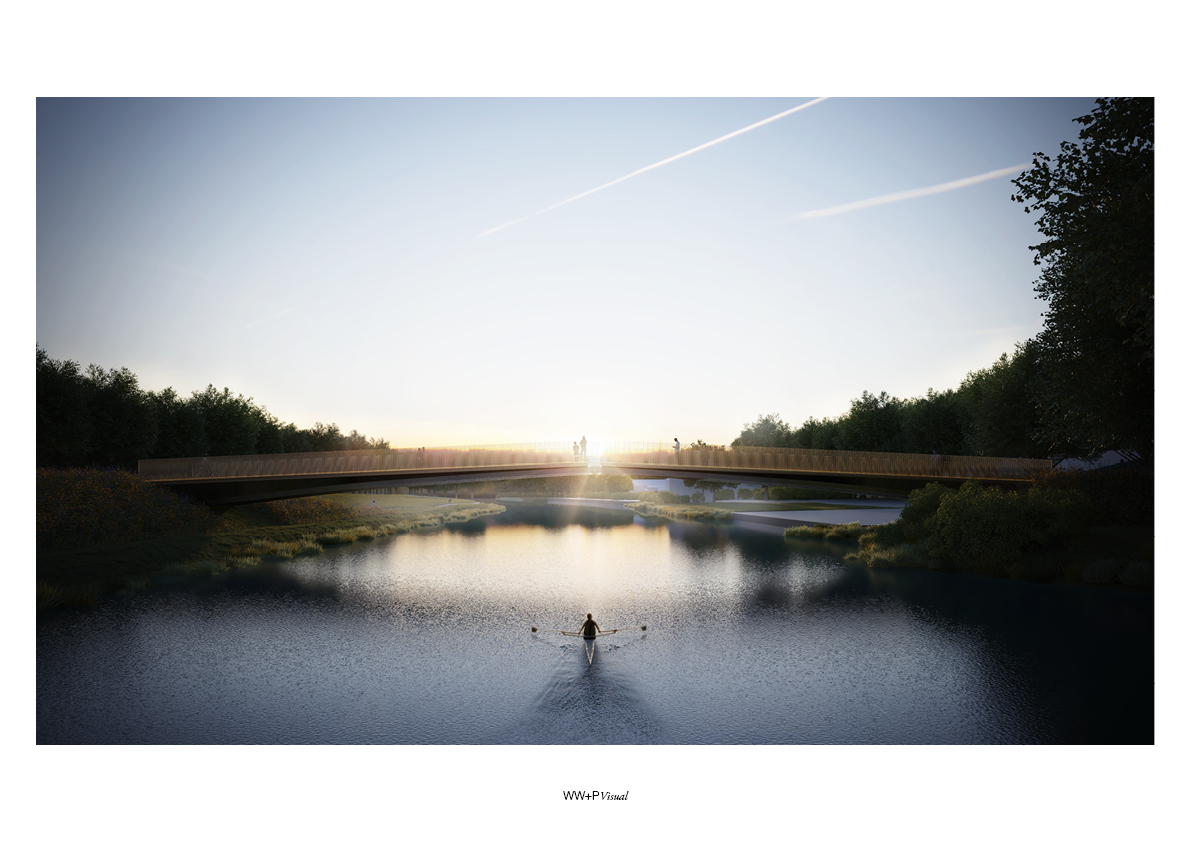
The details of this design are unclear, but it it is described as having three girders, with views down through the bridge to the river.

Third Place
Niall Montgomery + Partners / J. B. Barry and Partners / Billings Jackson / Conway McBeth / John Spain Associates / Scott Cawley


This is another steel girder structure, with a granite surface and extensive landscaping works. Standing stones are engraved with illustrations taken from the War Memorial Record Books.

Commended
Seán Harrington Architects

I expect there's an engineer involved, although the RIAI don't see fit to credit anyone other than the architects in their competition announcement. This design is an arch-supported stressed ribbon bridge, a graceful modern version of the original Lutyens proposal.

Commended
Bystrup Arkitekter and Designere ApS

The final design is stated as being in weathering steel, with a layout which tapers in plan to accentuate the visual perspective when arriving at the Memorial Garden. Of all the designs selected by the competition judges, this one feels the most out of place to me. I also think that forming the curved portal frame shape in weathering steel would be rather difficult.

Bonus entries!
The RIAI haven't released a gallery of any other entries, but here are two more that I've found on the internet. If anyone else would like to email me a copy of their entry, I'll add it here when I get a chance.

Cake Industries / BEaM


This is an attractive and ambitious design, with complex geometry, an interesting combination of materials, and a ramp down to the river bank. I'm only guessing, but I suspect the judges may have thought that it competed for attention rather than paid due deference to the War Memorial Gardens.

Fairfax and Sammons


If the quality and style of illustration won the prize, this would easily be my favourite, a beautifully rendered bridge in traditional style. I think the designer wasn't entirely clear whether they wanted an arch or a suspension bridge, and went for a bit of both.

Updated 2 June 2019
Matter Architecture / Webb Yates Engineers / Churchman Landscape Architects


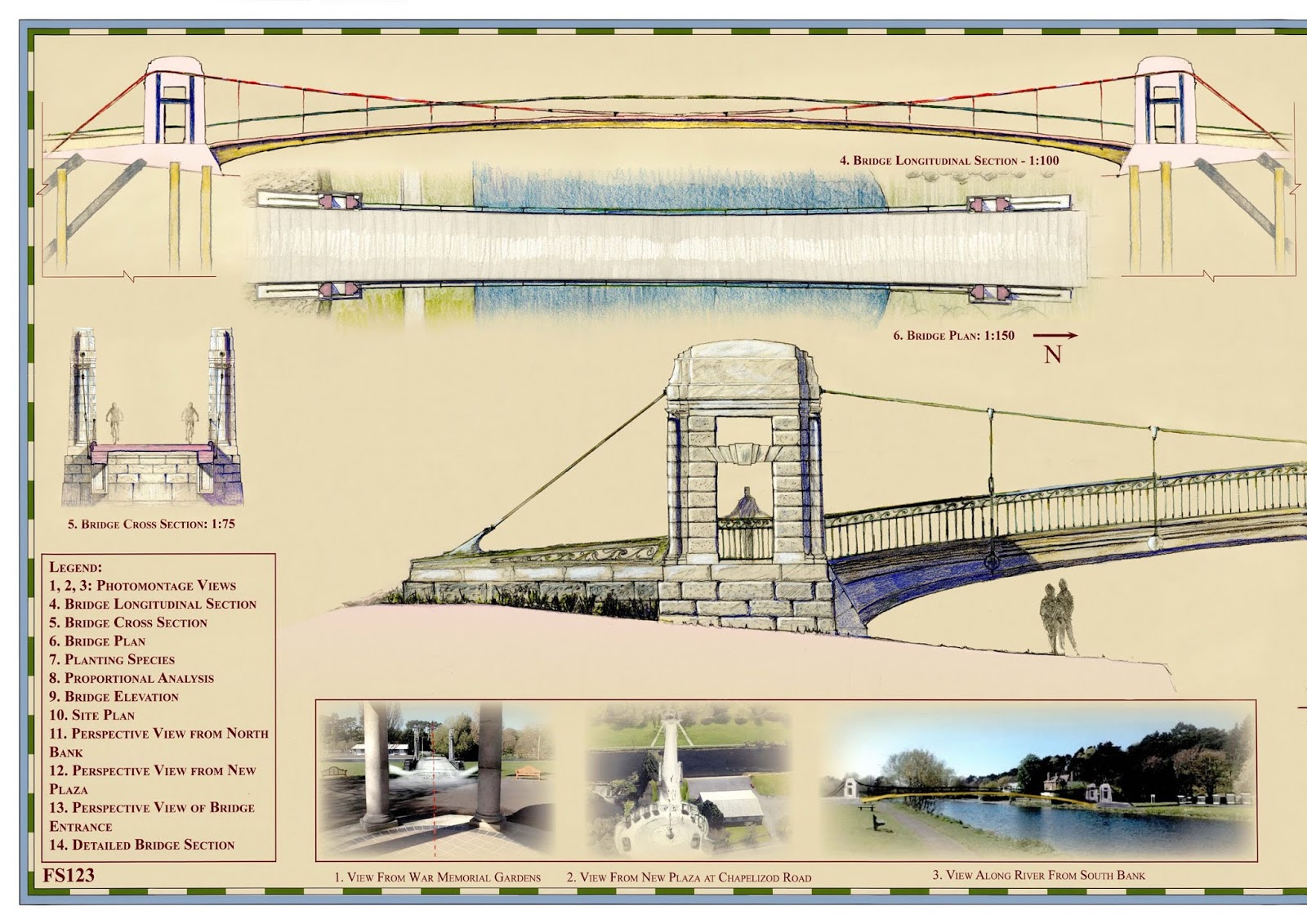
This entry was named the "Ring of Stone" bridge, comprising a loop of prestressed granite, with the inner parapet in solid granite and the outer made from recycled glass elements.

Studio Bednarski / Cundall / Robert Holden


A "living bridge" supporting an avenue of trees on weathering steel box girders.

Hugo Silvestre


With it's slender arch and balustrades-of-reeds, this has more than a few similarities to the winning design.

19 March 2017

"The Ha'penny Bridge, Dublin" by Michael English

In a recent post, I reviewed Annette Black and Michael Barry's "Bridges of Dublin", a survey of the many bridges spanning the River Liffey in Ireland's capital city. This time, I've been reading a rather more singular volume.

"The Ha'penny Bridge, Dublin" (Dublin City Council / Four Courts Press, 272pp, 2016) [amazon.co.uk] documents only one of Dublin's bridges, although certainly the best known.

Built in 1816, the Ha'penny Bridge (named for its toll) was the first iron bridge in Ireland. It was designed and fabricated by the Coalbrookdale foundry in Shropshire, the same as had built the pioneering Iron Bridge in 1779. The new crossing replaced an existing ferry, and was promoted by the ferry proprietors William Walsh and John Claudius Beresford as a private initiative.

The bridge has survived two centuries of often eventful Irish history, and this book wisely takes a very open-ended approach to documenting its subject.

The author, Michael English, is a graphic designer and photographer, and the book is beautifully presented and laid out throughout. It is filled with depictions of the bridge in art and photography, both historical and contemporary, and many of the excellent photographs are the author's. There are pictures of souvenirs, bridge poems, anecdotes, a plethora of directly and indirectly relevant material. In this respect it is a truly exemplary publication: any bridge would be proud to be recorded in this manner.

Different authors contribute different chapters to the book. The text drives onto, across, beneath and away from the bridge; treating it as a vantage point to explore the bridge, its surroundings, and its context from many angles.

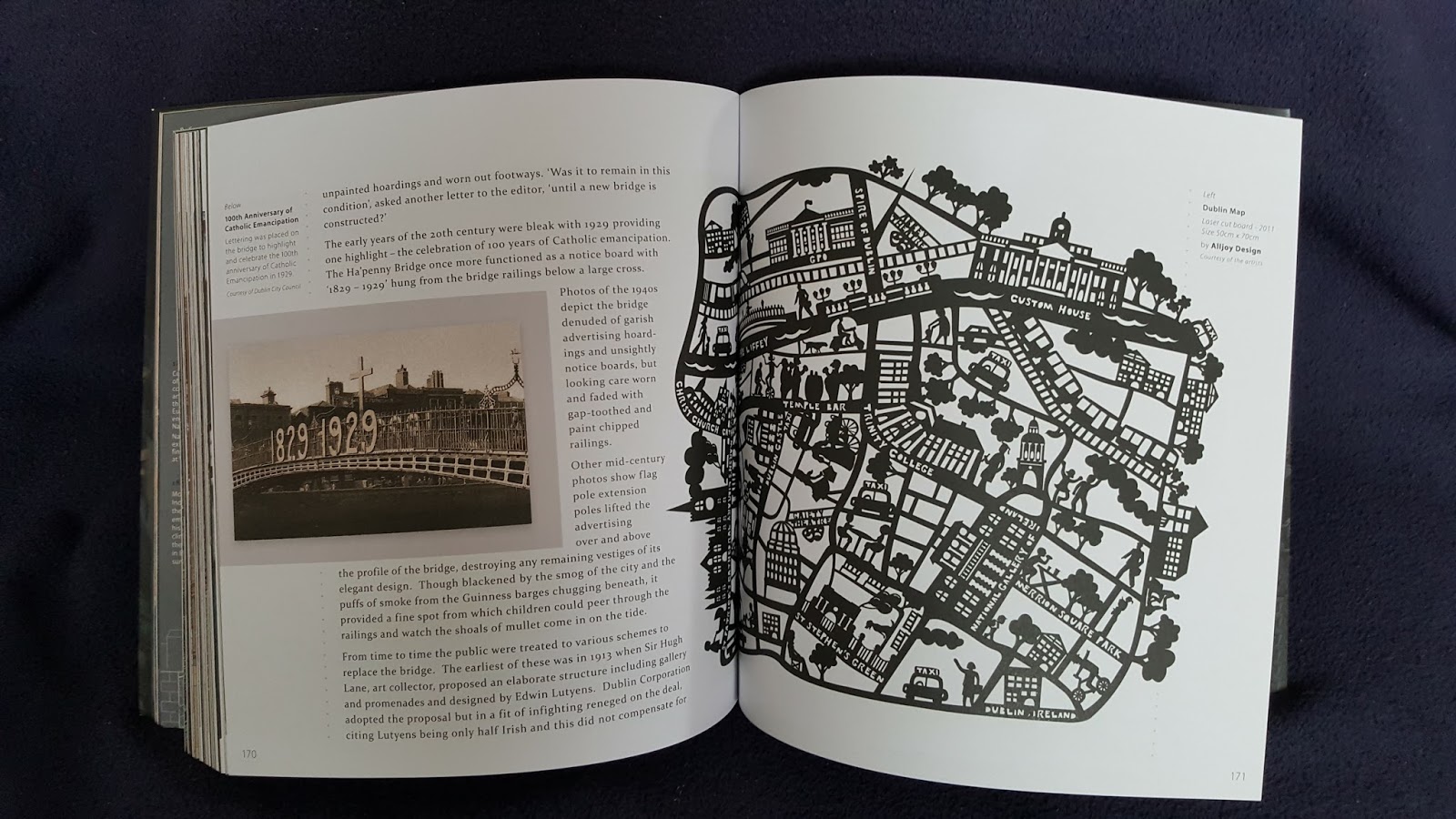
David de Haan offers a history of Coalbrookdale, source of Englands' best known iron bridge, and of the cast iron shipped to Dublin. This explains everything from the iron smelting process to the broader industrial transformation which allowed iron to challenge stone for economy. Gerard Smyth recounts the main points of the bridge's history, while Logan Sisley describes the the fortunately ill-fated 1913 plan to replace the bridge with the Hugh Lane Gallery.

Michael English recounts the history of some of the people who passed beneath the bridge most often: the Guinness company, whose barges transported Guinness stout below the bridge for many years. Annette Black offers a more cultural history of the bridge, probably my favourite chapter. It's a history of the bridge, but also a history of Dublin with the bridge as merely a convenient nexus. For me, this gets under the skin both of the bridge and the city: the bridge is not a monument, or an icon, but a site which features in people's everyday lives, a home to the homeless as much as a crossing for others.

I was a little disappointed in Michael Barry's chapter describing the bridge's 1998-2001 refurbishment and restoration. There are a few extracts from drawings and one engineering diagram, but I felt there was just too little detail on what appears to have been a very sensitive and carefully-considered project.

The penultimate chapter, by architect Seán Harrington, describes his design of Dublin's Millennium Bridge, now one of the main places from which to view the Ha'penny Bridge, and a structure where the various differences and similarities are constructive. The final chapter consists of Michael English's photographs of the bridge taken at different times of day and different periods in the year. These are excellent, well portraying way in which such a simple structure can appear so very different as hours and seasons pass.

Although the book is extensive in its coverage, one area where it is lacking is in any discussion of the Ha'penny Bridge's siblings. The distinctive form of its cast iron ribs, with two layers of quadrilateral braced ribs (like the more modern Vierendeel girder), was not new in 1816, indeed the appearance of the bridge was essentially a copy of Thomas Telford and Thomas Stanton's Meole Brace bridge, completed in Shropshire in 1811 and supplied by William Hazledine. The same or very similar design was used again in 1813 for the Cantlop Bridge, and then repeated after completion of the Ha'penny Bridge, in 1818 for the Cound Bridge (now reconstructed in Telford) and in 1823 at Stokesay. If you look at close-up images of Cantlop Bridge, the relationship is very clear.

Overall, however, this is an excellent book, highly relevant to anyone with an interest in Dublin or in bridges, particularly the role that they play in urban history. As already noted, it's a very attractive book, exceptionally well-illustrated, and a great example of what can be produced by people who allow their passion for a subject to drive what they do.

17 February 2017

"Bridges of Dublin" by Annette Black & Michael B Barry

Dublin City Council seem to have done a good job recognising the importance to the City (and tourists) of the city's River Liffey, and not only the river but the many bridges which cross it. They maintain an excellent website devoted to these structures, which includes not just informative material, but plenty of bridge-related stories and a substantial insight into bridge history and engineering generally.

The City Council has also published a series of books on the city's engineering history (in cooperation with Four Courts Press). "Bridges of Dublin: the remarkable story of Dublin's Liffey Bridges" (Dublin City Council / Four Courts Press, 256pp, 2015) [amazon.co.uk] is to some extent the in-print companion to the Bridges of Dublin website, and also owes a debt to Michael Phillips and Albert Hamilton's paper Project history of Dublin's River Liffey Bridges, published in the ICE's Bridge Engineering journal.

The book covers 24 structures in detail, every span across the Liffey from Lucan Bridge to the sea.

Each bridge is documented with a large 2-page photo (generally of excellent quality), often an aerial image, a location map, and a range of other images including drawings, historical paintings and etchings, and old photographs. More recent structures are often accompanied by photographs taken during construction.

The associated text provides not just a history of each bridge, or the stories associated with it, but something of a history of Dublin and wider Ireland. Most of Dublin's bridges were built in the 18th and 19th centuries, the period starting with the Acts of Union of 1801, and including the Irish War of Independence and Civil War of the 1920s.

Emblematic of the role of the various bridges as political symbols, many of the spans have been renamed at key points in history. An example is the Rory O'More Bridge, renamed in 1939 after a 17th century Irish rebel leader. The bridge had previously been renamed the Emancipation Bridge in 1929 (the centenary of Catholic Emancipation), having originally been named the Victoria and Albert Bridge when first opened in 1861. This repeated renaming recurs throughout the book, and makes an interesting contrasts to other cities, such as London, where the need to mark major political change has been absent.

The bridges also encapsulate a history of engineering, as in many major and historic cities. The oldest surviving bridge is Mellows Bridge, a three-span masonry arch structure completed in 1768 to a design by military surveyor Charles Vallancey. However, older bridges crossed the Liffey in both timber and stone, and more recent structures include spans in cast iron, wrought iron, early steel, reinforced concrete, prestressed concrete, and modern steel. The most recent spans include highly contemporary structures such as the James Joyce Bridge, Samuel Beckett Bridge, and Seán O'Casey Bridge.

Much of the interest in Bridges of Dublin is in the ability to see so clearly the many historical, technical and architectural differences between the many structures, as well as their close similarities and relationships.

The text is generally good at providing some structural engineering detail for those with a more technological interest, and at crediting designers and builders. The text is not critical in nature, but is highly informative.

In addition to the sections on each bridge, there is an introduction by City Engineer Michael Phillips, which primarily relates the history of bridge engineering, and a useful chapter which sites the history of the bridges more clearly in context with the history of the city and its river (again accompanied by some very well reproduced historical images). Guides are given to two possible walking tours for the main city bridges, and a series of technical drawings are included covering key bridges, although these are reproduced too small to be of much value.

Overall, this is a very impressive book, not only for students of Dublin's architectural and engineering history, but for anyone with an interest in bridges. There are few books which bring so much well-researched information together with such an excellent range of imagery, and I can definitely recommend it to interested pontists.

02 February 2015

Irish Bridges: 3. James Joyce Bridge, Dublin

Dublin is the lucky possessor of not one but two bridges by the renowned Spanish engineer, Santiago Calatrava. Both are highway bridges, spanning the River Liffey, built in steel and painted white. The James Joyce bridge is, by Calatrava’s flamboyant standards, an essentially modest design, completed in 2003. The other structure, the Samuel Beckett Bridge, is a case of extravagance at its most extravagant, a hugely gymnastic cable-stayed bridge with a passing resemblance to a harp, which is not only a piece of spectacularly ambitious sculpture, but adds to the spectacle by swinging open from time to time. On this very quick trip, I only had time to visit the simpler of the two bridges.

Designed in collaboration with Roughan O'Donovan, the James Joyce Bridge is one of Calatrava's better structures. It is relatively straightforward in conception, with two steel arches inclined outwards from a central highway, supporting the road and footways and helping define attractive and generous pedestrian spaces.

High strength Macalloy steel bars connect the deck to the arches, each hanger consisting of a pair of bars in a manner typical of Calatrava designs. The footways are supported on crossbeam cantilevers, and have a glass-block deck and glass-panel balustrades.

The overall form of the bridge is attractive from almost every perspective, but what I admire most about this bridge is the detailing, which has clearly been done with considerable care. It's a bridge simple in overall concept yet complex in the detail; I like it a lot.


Further information: