Showing posts with label Footbridge 2014. Show all posts

26 July 2014

Pedestrian Bridges of London: A Short Guide


Updated 27th July 2014 - THIS OFFER IS NOW CLOSED (see below)

I mentioned this little booklet recently. It was given free to attendees at the recent Footbridge 2014 conference in London. It is based on (much shortened) articles about significant footbridges in London, with all text and photos contributed by The Happy Pontist.

There are twenty pages, covering the following bridges: Bridge of Aspiration; Challenge of Materials Footbridge; Millennium Bridge; Golden Jubilee Footbridges; Chelsea Bridge Wharf Link Footbridge; St Saviours Dock Bridge; Royal Victoria Dock Bridge; South Quay Footbridge; West India Quay Bridge; Plashet School Footbridge; Stratford Town Centre Link; Green Bridge; Rolling Bridge; Merchant's Square Footbridge; Sackler Crossing; Xstrata Treetop Walkway.

The booklet also provides some (very) brief details on significant bridges and structures encountered along the River Thames, the conference's Gala Dinner boat cruise route.

I have eight of these booklets left over from the conference, and I will post them to the first people to email me (happypontist at gmail dot com), having first made a donation to Bridges to Prosperity. I wrote about B2P and their excellent efforts to build low-cost footbridges in the developing world, way back in 2009.

The booklets will never be reprinted, so this is a unique chance to get a copy.

It's very simple:
  1. Donate to B2P whatever amount you wish, although an absolute minimum of US$5 please.
  2. Email me your address and a copy of your B2P donation receipt - if you want to keep any details private, just take a screenshot and cut out any private bits.
  3. This is a bit silly since I blog anonymously, but I will sign the booklet on request. Minimum US$10 donation for a signed copy.
  4. I will post you a copy of the booklet, free of charge. Please bear in mind that I am covering international postage when you decide how much to donate to B2P!
  5. I will post here when all copies are gone, but there can be no refunds - if you donate, and I've run out of copies, never mind, at least B2P will benefit!
  6. Did you attend the conference and already have a copy of the booklet? That's great, but please consider donating to B2P anyway, they're a great organisation.
Updated 27th July 2014 - THIS OFFER IS NOW CLOSED

All the spare booklets are now allocated, many thanks to those who have donated to Bridges to Prosperity! I have also made a donation myself, and together we have raised US$350 to support their excellent work around the world. I'm absolutely delighted to have helped create this opportunity.

22 July 2014

Footbridge 2014

I thought I'd try to write a brief summary of Footbridge 2014, held over three days last week at Imperial College in London.

Much of the conference was in the usual format: a series of plenary sessions with twelve keynote presentations (substantially more than Footbridge 2011), accompanied by various themed parallel sessions where the bulk of the papers were presented. These ran in triplicate, so I almost certainly missed more amazing presentations than I saw. If I get time, I'll write here about a few of the particularly interesting presentations. I also barely scratched the surface of the exhibition, which was a shame as there were some interesting products and companies on show.

The conference was very busy: I had time to visit a handful of London bridges the day before the event, but once it started there was so much of interest to see, and so many interesting people to meet, that I never had time to go off-campus.

One of the undoubted highlights was the first night, which featured "Footbridge 10-20", a session where presenters had to speak over only ten slides, each shown for exactly 20 seconds. This is a variant on the PechaKucha presentation format, but half the length, and all the better for it. It really forced speakers to be concise, and if they were boring, well, they were gone quickly and on to the next. The four highlights, for me, were presentations on Thomas Heatherwick's absurd Garden Bridge ("Boon or boondoggle?" - I don't think there's much doubt which it is); "freaky London bridge facts" (one of few presentations not by a bridge designer, builder or client); a comparison of the love of "sexy" (i.e. "iconic") bridges with scopophilia, in its sense as a sexual perversion; and a much-applauded tour of bridges in Hollywood action films, particularly science fiction and fantasy films, discussing how they tend to defy the laws of physics. The last was supported by a paper in the main body of the conference, from which this picture of Asgard's rather improbable Bifrost Bridge is taken.


The second night of the conference was the Gala Dinner, a cruise down the River Thames on a glass walled boat. I know London well, but this was a marvellous night, great company, great sights, and the chance to experience very different characters of the city as daylight faded into night.

The keynote presentations were generally of a very high standard, thought-provoking and wide-ranging. Several showed concern with the philosophy and ethics of design, with Andreas Keil, Marc Mimram, Jürg Conzett, Laurent Ney and Martin Knight all addressing the "why" and "how" of footbridge design as much as the "what".

Keil presented ten objectives for a designer, drawn from the vocabulary of a product designer, and illustrated them with examples from the Schlaich Bergermann and Partners portfolio. My favourite objective was to employ "as little design as possible", illustrated by the Bleichwiesesteg (pictured, right).

Conzett's talk addressed the question of how engineers could draw on "inspiration" without having to compromise their essential character and become "artists". Conzett's inspirations are often historic, such as Brunel's Chepstow Railway Bridge, and he often uses images from the past to provide the key to modern design problems, whether of broad conception or with regard to details. Conzett's timber Murau Bridge (pictured, left), was shown as one structure inspired by the Chepstow span. The approach is like that of a detective, treating historical artefacts as clues to discover a hidden and unsuspected new design solution.

Laurent Ney offered nine design principles, developed in collaboration with Chris Poulissen. These were broadly aligned with Vitruvius's famous three principles of Utilitas, Firmitas and Venustas. Many of Ney and Poulissen's principles are primarily ethical: relating to social integration, minimal waste, recognition of diversity, shared ownership ahead of ego. One principle, "towards an appealing creation narrative", asks for design and construction to embody the culture within which they operate, to create stories with a wider social resonance beyond the specifics of the project.

The conference closed with Martin Knight's talk, "Bridges for places, bridges for people". Like Ney, he was concerned with the role a bridge plays in society beyond the purely functional. The rebuilding of the bridge in Mostar (pictured, right) was offered as an example of a bridge playing both a practical and also a symbolic role, an act of rehabilitation and a site for celebration. He urged designers to "zoom out" and look beyond the bridge itself to its place in a wider context.

I can only scratch the surface of the conference here. Several of the other keynotes were highly informative, and indeed two lectures on footbridge dynamics were both quite amusing, not something often said about this topic. If time permits, I'll pick out a few further papers and projects from the conference, and post here again.

19 July 2014

Footbridge Awards 2014 winners

The winners of the 2014 Footbridge Awards were announced a few days ago at the Footbridge 2014 conference in London. I'll hopefully have more to say about the conference soon, but for now, here are the winning bridges. I posted the full shortlist previously.

I will keep my own comments to a minimum, but would welcome further opinions via the blog comments facility.

Short span
Winner - Smedenpoort Twin Bridges, Bruges, Belgium - Ney and Partners
This is a truly flabbergasting design. I doubt that many engineers other than Ney and Partners would have had the faith that they could make such slenderness work.

Highly Commended - Bleichwiesensteg, Backnang, Germany - Schlaich Bergermann and Partners
I keep staring at this bridge design and wondering about its peculiarly upside-down quality - the compression strut and tension hinge look like they should be a tension tie and compression hinge.

Highly Commended - Campusbrücke Opladen, Germany - Knippers Helbig / Knight Architects
I'm not 100% sure that I understand this bridge, which is geometrically complex and difficult to "get" from just one image, but I do love the use of simple patterns to generate considerable visual interest.

Highly Commended - Vluchthaven Bridge, Amsterdam, Netherlands - Ney and Partners
I'm not sure what I like better about this, the rail-less balustrades, or the folded steel plate deck.

Medium span
Winner - Jarrold Bridge, Norwich, UK - Ramboll
Discussed here back in 2012.

Highly Commended - Geniedijk Bridge, Netherlands -
I can't find a lot of information on this bridge on the internet. The V-shaped theme and use of weathering steel are attractive, as is the detailing, but I do dislike bridges with 3m tall anti-vandal barriers - are they really necessary, or did the client only think they would be?

Highly Commended - Slinky Bridge, Oberhausen, Germany - Schlaich Bergermann and Partners / Tobias Rehberger
When I first saw pictures of this bridge, I found its frivolity, particularly the "slinky" spiral itself, somewhat garish and dispiriting. Closer examination reveals a very well detailed stressed ribbon bridge, and what looks to be an attractive and jolly combination of colour and shape.

Highly Commended - Media City Footbridge, Salford, UK - Wilkinson Eyre / Ramboll
I visited this bridge in 2011.

Long span
Winner - Bow River Bridge, Banff, Canada - StructureCraft
This was up against some pretty impressive competition on the long span shortlist. It's unusual to see timber in bridges this long (an 80m central span), certainly of the beam type.

Highly commended - Peace Bridge, Londonderry, UK - AECOM / Wilkinson Eyre
Sometimes it seems there is little more to be said in the hi-tech, modernist style which Wilkinson Eyre have made their own, but the Peace Bridge is something new within that space (overlapping self-anchored suspension spans), and also a very well detailed example of how it should be done.

Refurbishment
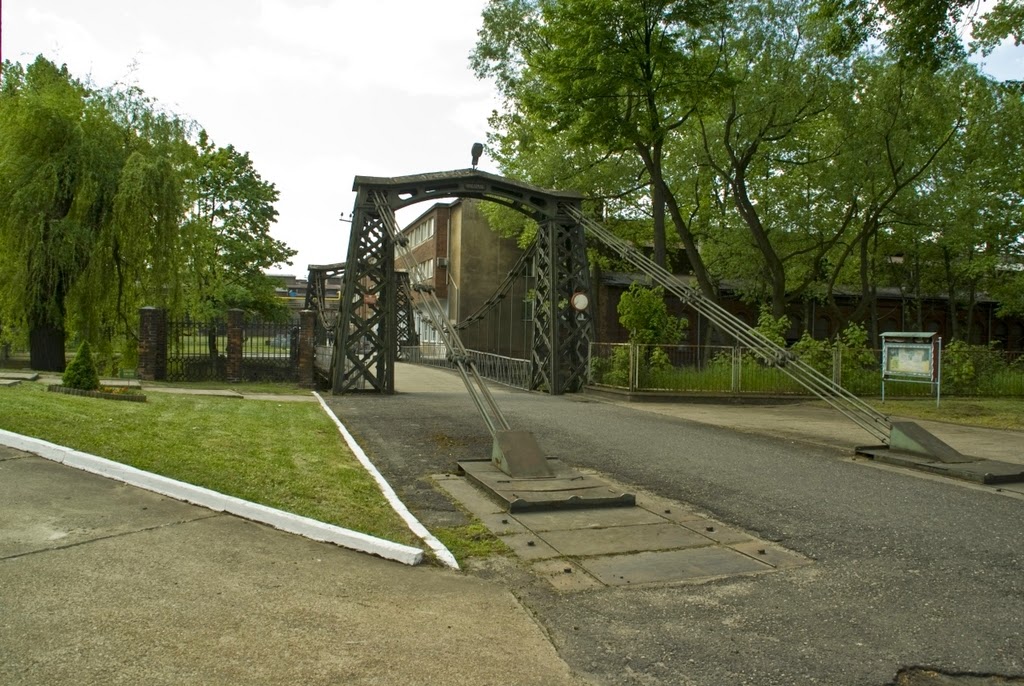
Winner - Mala Panew River Bridge, Poland
The write-up in the Awards booklets indicates this to be an exemplary restoration and strengthening of a historic bridge, built in 1827. A paper was presented at the conference, but I can find no useful information on the project online.

Jonathan Speirs footbridge lighting award
Winner - Castle Green Bridge, Taunton, UK - LDA Design / Moxon Architects / Flint and Neill
This strikes me as the sort of design that the late Dan Flavin would have put forward if he were designing visitor access ramps rather than minimalist art installations. That can only be a good thing, in my opinion.

16 July 2014

Pontist in print

I'm currently visiting Footbridge 2014, and very pleased to note that the Happy Pontist is now in print for the first time. All the attendees at the event are being provided with a short guide to the pedestrian bridges of London in booklet form, with all the text and images provided from past blog posts here (edited for length!)

If you're attending the conference, and want to read more about any of the bridges featured in the booklet, just google "Happy Pontist" and the name of the bridge, and you should find a link to the relevant post.

17 June 2014

Footbridge Awards 2014

The shortlist has been announced for the triennial Footbridge Awards. Winners will be announced on 16th July at the Footbridge 2014 conference in London.

I've posted links below to sites where you can find more information about the entries. I've only visited two, the Media City Footbridge and the Stratford Town Centre Link. I've also featured the Jarrold Bridge here, although not visited it yet. Most of the others are new to me. Some of them are quite brilliant, so it's well worth taking time to browse through the links below.

Short span


Medium span


Long span


Refurbishment


Jonathan Speirs Footbridge Lighting Award