13 November 2016

Bridges news

I'm keeping it short and to the point: a few items of bridges news I spotted recently ....

London bridge lighting contest shortlist unveiled
This is being promoted to make London more of a "24-hour city", as if we didn't have enough light pollution already.

Mathematical bridge model kit
Do you know anyone who'd like one of these for Christmas?

Vision of swivelling bridge is unveiled for Renfrew Riverside project
File under "what the hell were they thinking about?!"

Richard Meier’s Cittadella Bridge inaugurated in Alessandria
Italian bridge 20 years in the making.

St Saviour’s Dock footbridge to be replaced
21 year old bridge is officially knackered.

New £7 million footbridge in Telford gets council backing
30 year old bridge also knackered, to be replaced with covered bridge design

Santiago Calatrava wanted pretty lights for the Peace Bridge but they couldn’t stand the cold
$700,000 bill to replace 300 light fittings.

New South Side pedestrian bridge spanning Lake Shore Drive a striking design
"Sometimes, a bridge is more than just a way to get from Point A to Point B."

New Dedicated Tram Stop Pedestrian Bridge for QMC Approved
Check out the visualisations, which show the proposed bridge floating above its support pillars rather than connected to them with anything suitable!

06 November 2016

1961 film of Hammersmith Flyover construction

Three years ago I visited London's Hammersmith Flyover, one of the most innovative bridges to be built in Britain in the last century. It was one of the world's first precast, segmental, prestressed concrete viaducts, constructed using a complex kit of different concrete elements.


One of my readers recently alerted me to a 1961 film documenting the bridge's construction, produced by the Cement & Concrete Association and available on the BFI website.

This is an excellent film, well worth watching, for many reasons. It remains a hugely informative documentary, full of technical detail on all phases of the bridge's construction. There's plenty to learn not only about how bridges were built over 50 years ago, but about how they are still built today.

One further attraction is the somewhat Cholmondley-Warner style of narration, but probably the most interesting aspect is the difference in approach to worker and public safety from 1961 to today. You could watch this film while marking off a bingo scorecard of what would now be considered quite unacceptable safety practices. In some sections, you'd struggle to keep up, there are so many.

I definitely recommend taking a look, it's an excellent film of considerable historical value.

05 November 2016

Swedish Bridges: 9. Norrbro, Stockholm

This is the last bridge I visited in Stockholm, and I think it's also the oldest. Designed by Erik Palmstedt and Carl Fredrik Adelcrantz, it was completed in 1797, replacing a previous timber bridge which had been extensively damaged by flooding in 1780. The part of the bridge that I saw comprises three 16m span stone arches, although the structure continues south on a series of vaults on the island, and a further arch span over another waterway.

Klas Lundkvist's report Norrbro och Strömparterren, available online, has a great deal of information on the bridge and its construction. Lundkvist suggests the design was inspired by French architecture, particularly Perronet's 1774 Pont de Neuilly.

A 1781 drawing shows that the masonry piers are supported on timber piles. A later drawing shows the piers constructed on the pilings by layering stone within an open-topped timber caisson, the base of which was left in place to form a timber layer above the piles. This method was reportedly also used for the Pont de Neuilly. Below the bridge, it can be seen that there are actually two parallel sets of arches, and holes are visible which would have formed the support positions for temporary timber centering during construction.

The bridge is in very good condition, with the ornamental balustrades in particular looking like they have been recently renewed.

I think the arches and piers are too squat for the bridge to be considered truly elegant, but it certainly gives the impression of robustness, and I'd expect that having lasted for 219 years so far, it could quite easily last the same again.


Further information:

03 November 2016

Swedish Bridges: 8. Riksbron, Stockholm

Heading east along the Norrström, the next bridge is the Riksbron (roughly, the "State bridge").

This links Norrmalm to Helgeandsholmen, a small island which is home to the Swedish parliament building.

A bridge was proposed at this location in 1712, but nothing was built until 1907, when a steel truss structure was erected. This was replaced in 1931 by the bridge which stands there today, designed by engineers Axel Björkman and K A Wickert  with architect Ragnar Östberg (who was also involved in the Stadhusbron).

The bridge is a 44m long reinforced concrete arch, with a hinge at the crown. It's a simple, elegant design, helped by the shallowness of the arch and the inclusion of only limited detail to break up the flatness of the concrete. The metal parapets are attractive and lightweight, and it's a significantly better looking bridge than the next one I'll be sharing here.


Further information:

01 November 2016

Swedish Bridges: 7. Vasabron, Stockholm

I've got three more Stockholm bridges to feature, all of them spanning the Norrström waterway and connecting Stockholm's Old City, Gamla stan to Norrmalm.

Vasabron is named after King Gustav Vasa.

There was an unsuccessful attempt to build a bridge here by British-Swedish engineer Samuel Owen in 1843. A design competition was held in 1868, with the present bridge being built from 1875 to 1878 by AB Atlas, to the design of Emil Edvard von Rothstein.

The bridge has seven metal arches with a maximum span of 32m. A plaque on the bridge states that the bridge is cast iron, which is clearly incorrect as the bridge can be seen to be riveted from below. Wikipedia states that the design contest was for a cast iron bridge, and that the bridge is actually built of cast steel. Given the date, this sounds pretty unlikely, and there's nothing about its appearance to support this. The ornate parapets and spandrel infills are presumably cast iron, but the main structure and associated bracing give the appearance of wrought iron.

It's a simple and elegant bridge, although I can't help feeling that the ornate elevations would benefit from being painted in a more interesting combination of colours.


Further information:

30 October 2016

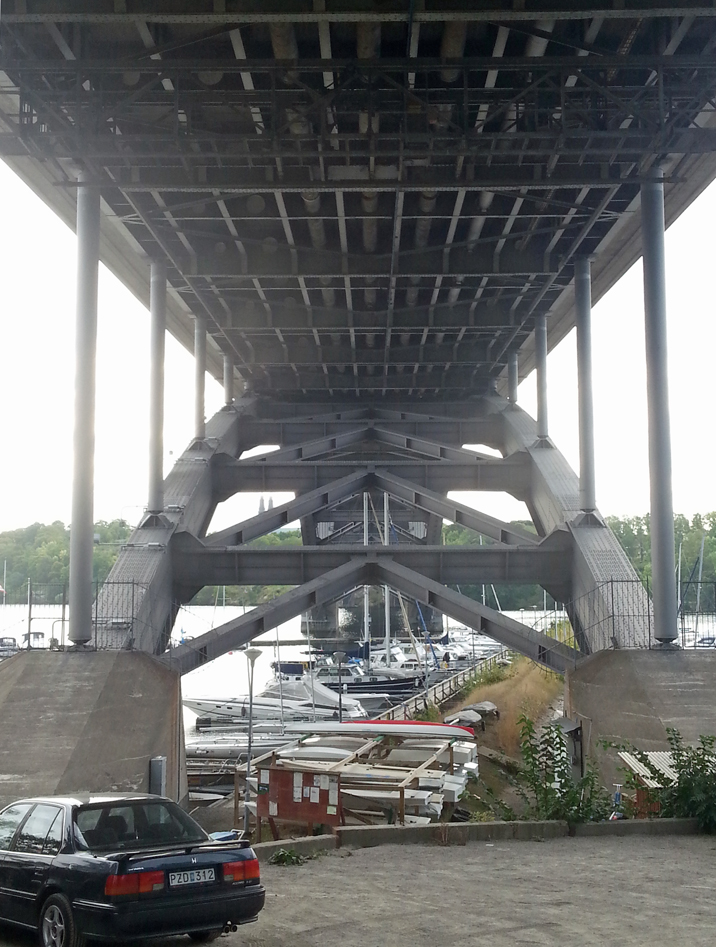
Swedish Bridges: 6. Västerbron, Stockholm

This massive bridge spans the Riddarfjärden, a major waterway splitting the north of Stockholm from the city's southern part.

Completed in 1935, the main part of the bridge comprises two enormous steel arches spanning respectively 204m and 168m, along with approach structures on each bank. It's reported to be the largest steel arch span in Sweden.

The bridge was the result of an international design competition, with 72 entries, which concluded in 1930. The winning entry was credited to the Berlin architects Otto Rudolf Salvisberg, Wilhelm Büning and Wilhelm Maelzer. However, the actual design contract was awarded to the 3rd-prize winning architect  Paul Hedqvist, who worked with his partner David Dahl and with the structural engineers Ernst Nilsson and Salmon Kasarnowsky, a Swedish team. The contractors were Dortmunder Union and Motala.

The Swedish Wikipedia article has some good photos of the bridge under construction.

The arch comprises riveted steel box girders, connected in plan with K-bracing. Pin-footed tubular columns support the deck grillage. Reinforced concrete skewbacks carry the arch thrust into the foundations.

This is a simple and admirable bridge, the type of structure where it's hard to think what alternative solution would have been appropriate. The span lengths are quite different, but the layout did not look out unbalanced from anywhere that I stood.

The columns are pleasingly slender, ensuring that the deck and arch elements dominate from a distance, and the columns don't present too much of a "forest" appearance when viewed at a closer angle.

It's pleasing to see that the bridge parapet has attracted numerous love locks (see link below), especially given its reputation as a "suicide bridge", at least until anti-suicide fencing was added in 2012.


Further information:

21 October 2016

Swedish Bridges: 5. Stadshusbron, Stockholm

As I reached the end of my walk down Klara Sjö in Stockholm, heading towards the junction between this waterway and the larger Riddarfjärden, this was not the bridge I was expecting.

There has been a bridge here connecting mainland Stockholm to the island of Kungsholmen since 1672. At that time, less of the city had been built out into the water, and the bridge was apparently a 500m long pontoon bridge, called the Nya Kungsholmsbron. As the waterway was narrowed, the bridge was rebuilt on several occasions, including as a steel swing bridge in 1868.

That was replaced around 1919 with the present structure, which consists of a stone-clad concrete causeway punctured by shallow flood relief culverts, with a twin leaf bascule span. The bascules were fixed in place in 1949. In 2012, the bridge deck was completely replaced by a new single span structure fabricated in Poland.

Before reaching the Stadshusbron, I'd passed under the tall viaduct Barnhusbron, plus three other spans, each of which was significantly larger than the Stadshusbron, which resembles more of a barrier than a bridge. However, the adjoining ground levels here are lower than those I had passed, and the bridge is situated immediately adjacent to Stockholm's City Hall, the Stadshuset. Constructing a higher level bridge would have been inappropriate next to such an architecturally prominent building, and there was presumably little reason to provide a larger span opening.

It's interesting how this choice completely changes your perception of the area. It makes Klara Sjö feel like a broad canal ending in a cul de sac. It's a useful reminder that bridges should sometimes be distinguished only by their modesty.


Further information: